
The No-Win Scenario
The idea of “veto” has a long and sordid history in polyamory. Back when I started this road to ethical non-monogamous relationships in the late 1980s, before the word “polyamory” was even in circulation, people pretty much accepted as a given that if you started shagging someone your main or “primary” partner didn’t like, and they told you to stop, you’d stop. The only real relationship was that primary relationship, after all, and it was your duty to protect it.
I have evolved quite a lot since then. I now believe quite strongly that the moment one of your partners tells you to stop seeing another partner, you’re totally buggered. Any choice you make will be the wrong choice. There is no good or graceful way to respond.
My own experiences with veto
I’ve been on the receiving end of veto, both as a person being ordered to give up a relationship and as a person vetoed by someone else. It’s not my place to speak to someone else being ordered not to see me, but I certainly can speak to the experience of being ordered to stop seeing another lover.
I’ve been in this situation, several times. Sometimes I’ve continued dating. Sometimes I haven’t. Every single time without exception, I’ve regretted the choice I made.
In two of the most notable cases, my first wife—who self-identified as monogamous even though we began our relationship in what would today be called a “polyamorous quad” (though of course we didn’t have that language then) and had several long-term boyfriends—vetoed my relationship with another partner of mine, and then insisted that not only could I no longer be romantically involved with her any more, I could never again speak to her either.
In the second, my partner “Amber” vetoed my relationship with another partner who I’ll call “Tina.” I met Tina (not her real name) at a party hosted by a mutual friend. We connected instantly like wildfire, with that dizzying, blow-your-socks-off chemistry that some people think of as “love at first site.” Tina and I soon started dating, and shortly afterward, Amber and Tina started dating as well.
Amber and Tina were a very poor match for each other, and soon reached a point where they could not be in the same room together without yelling at each other. Amber broke up with Tina, then demanded I do so as well. I’ll never forget her words: “Can you believe Tina still thinks she gets to be with you?”
I learned from these experiences that the moment you find yourself in a position where someone is telling you not to date another person, you’re screwed. It doesn’t matter why they’re telling you not to date, or whether or not they’re right, or what their reasons are. It doesn’t matter what choice you make. No matter what you do, you are going to be a villain in someone’s eyes.
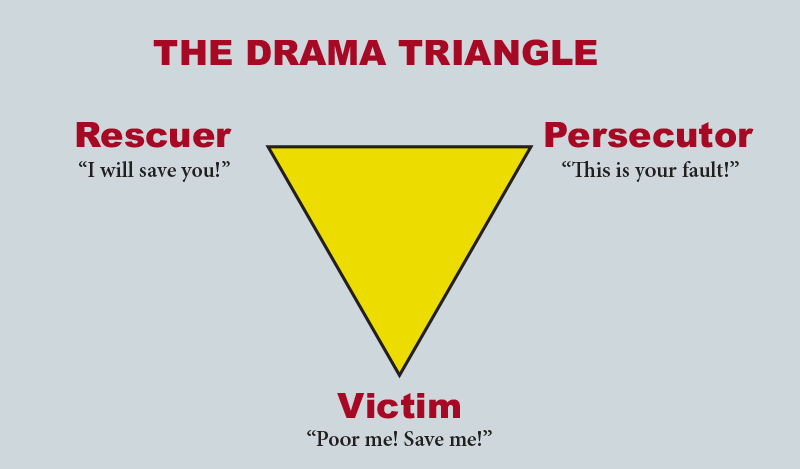
“So-and-so dumped me because their friends said to, not for anything I did!” makes you a monster to some people. “So-and-so chose a new piece of ass over us!” makes you a monster to others. There’s no choice that can’t be spun to put you in the “persecutor” slot of the Drama Triangle, and whatever you do, someone will be aggrieved.
Find your place
And that’s not even the shittiest part. The shittiest part of this situation is that not only are you absolutely guaranteed to aggrieve someone, whichever choice you made, but from that moment on there’s a sword of Damocles dangling over your head.
If at any point something should go wrong with the person you chose—if you listen to your friend and then later alienate that friend, or you keep dating your partner and then break up, guess what? Your former friend and your ex have a common enemy.
You.
And nothing brings people together like a common enemy.
In the case with Amber and Tina, for example, Amber later broke up with me to start dating a monogamous man, who she then broke up with to start dating a mutual friend. She would later say that I was “abusive” for breaking up with Tina at her demand. And this is, unfortunately, the way this kind of situation often plays out, which is why I believe there is no right solution; the moment a lover demands you break up with another lover, the ground has been planted with the seeds of an ill harvest, no matter what you do. I believe with absolute certainty that had I chosen to protect my relationship with Tina—which, looking back, would have been a better choice—Amber would tell stories of my evil for that, too.
The only solution I know of, and it’s a shitty solution, only marginally less bad than any other, is to have no truck with the kind of people who would ask you to make that choice.
Veto as abuse
If you read any book on abuse, or any resources about abusive relationships or abusive dynamics, you will find that controlling another person’s social interactions is one of the defining elements of an abusive relationship.
Abuse takes many forms—physical, verbal, emotional—but common to almost all abuse dynamics is the control of the survivor’s social connections by the abuser. Whether that’s the abuser demanding that the survivor doesn’t have other friends (or other friends of the “wrong” sex), social isolation is almost invariably a tool of abuse.
Any behavior in which your partner prevents you from seeing friends or family can be a sign of abuse.
As the DV Connect site says:
Social isolation abuse is behaviour that aims to cut you off from your family, friends, or community. It can also involve a person or people trying to damage your relationships with others. People who are socially abusive may also attempt to make you look bad or ruin your reputation. Social isolation abuse can include things done in the home, in public, over the phone, or on the internet and social media.
For many years, I believed that polyamorous relationships were more resistant to abuse than monogamous relationships, partly because I wrongly believed that isolation in polyamorous relationships is more difficult. I no longer believe that is the case, and in fact I have come to the conclusion that partners who attempt to control your other romantic connections may in fact be behaving abusively.
And in fact, one of the ways that polyamorous abuse manifests differently than abuse in monogamous relationships may be the form that the abuser’s control of the abuse survivor’s social circle takes.
In monogamous relationships, we’re accustomed to seeing control over the survivor’s social connections in terms of isolation—the abuser isolates the victim. But something I’ve seen in polyamorous relationships is a different form of control—the abuser tells the victim who to socialize with, in some cases even who the victim should date! The abuser may choose people that he or she feels are ‘safe,’ perhaps even people in the abuser’s sphere of control, and tell the survivor, “I want you to date this person” or “I want you to have sex with this person.”
In a monogamous context, that doesn’t make sense, but when we start to think in terms of “controlling the survivor’s social interactions” rather than “isolating the survivor,” it becomes easier to recognize this as abuse. Social isolation is control over someone’s social circle...but so is telling them who to spend time with, have sex with, or be in a relationship with.
No winning move
Don’t be friends with anyone who would tell you who you ought or ought not have in your life, and for God’s sake never date such a person.
There are two downsides to this:
- You’ll cut a lot of people out of your life. A lot, and I mean a lot, of people feel it’s within their purview to venture ideas about who you should or should not allow in your personal inner circle, socially or romantically (or both).
- You have to get really proactive about developing those partner selection skills.
It’s okay to solicit input (“Hey, what do you think about me and so-and-so, think we’re a good match? No obvious warning signs?”), but make it clear the decision rests with you, not with them.
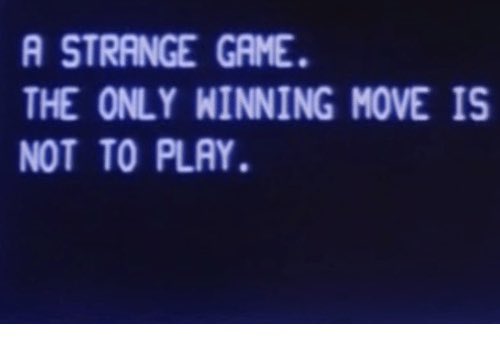
What will I do? These days, having ridden this ride and learned from experience there is no right choice, I believe the only winning move is not to play. The moment a person attempts to exert control over your romantic connections by exercising a veto, whether it’s a direct veto (“stop seeing so-and-so now”) or an indirect veto (placing pressure on you or using drama, arguments, passive-aggressive behavior, or other psychological pressure to get you to stop seeing your other partner), it’s probably time to go.